Does Welding Fume Extraction Need An LEV Test?
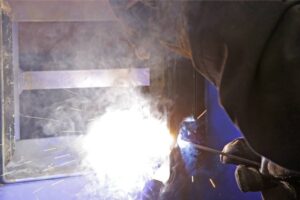
Yes. Extraction fitted to control welding fume is local exhaust ventilation (LEV), and under the Control of Substances Hazardous to Health Regulations 2002 (COSHH) it needs a thorough examination and test at least once every 14 months. Since HSE’s February 2019 safety bulletin, almost every indoor welding bay is expected to have engineering controls such as LEV, so far more sites now hold welding extraction that falls under that duty. This guide covers what changed, which kinds of welding extraction need testing, how often, and what the test involves.
If your welding extraction is due a test, send a list of the systems and the site address to info@gsbinspections.co.uk and we aim to come back with a quote within 48 hours.
What Changed For Welding Fume In 2019
In February 2019 HSE issued a safety bulletin on mild steel welding fume. It said new evidence showed that exposure to all welding fume, mild steel included, can cause lung cancer, and that HSE was strengthening its enforcement expectation for all welding fume with immediate effect.
The bulletin set out three points:
- General ventilation does not achieve the control needed.
- Controlling the cancer risk requires suitable engineering controls for all welding indoors, such as LEV.
- Where engineering controls alone cannot control exposure, adequate and suitable respiratory protective equipment (RPE) should be provided, and appropriate RPE should be provided for welding outdoors.
HSE also said it would no longer accept any welding carried out without suitable exposure control measures, regardless of how long the welding lasts, and that engineering controls must be subject to thorough examination and test where required.
Welding Fume Extraction Counts As LEV Under COSHH
LEV is any engineering control that captures a contaminant at or near its source and carries it away. For welding, that covers:
- On-torch extraction, where the capture point is built into the welding gun
- Fixed extraction arms and hoods over benches and welding bays
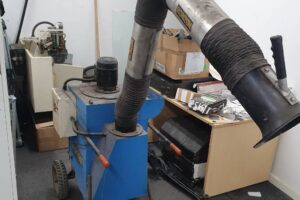
- Mobile fume extractors with flexible arms, wheeled from job to job
- Extracted welding booths and downdraught or backdraught benches
HSE’s LEV pages include a thorough examination and test record outline written specifically for on-tool extraction, so smaller and portable units are not outside the duty because of their size. If it is there to control welding fume, treat it as LEV.
How Often Welding LEV Needs A Thorough Examination And Test
Regulation 9 of COSHH requires LEV plant to be thoroughly examined and tested at least once every 14 months. The employer must keep a suitable record of each examination and test, and of any repairs carried out as a result, for at least five years.
A new system should also be commissioned before it is used. The commissioning report records how the system is intended to perform, and every later test is measured against it. HSE’s commissioning guidance says the report should include the date, the duty holder’s name and address, the commissioner’s name, job title and employer, and quantitative results such as air flows, face velocities and static pressures.
When Grinding Shortens The Welding LEV Test Interval
Schedule 4 to COSHH sets shorter maximum intervals for LEV used with certain processes. Two can apply in fabrication shops:
- Processes, other than wet processes, in which metal articles (other than of gold, platinum or iridium) are ground, abraded or polished using mechanical power, in any room for more than 12 hours in any week: at least every six months.
- Processes giving off dust or fume in which non-ferrous metal castings are produced: at least every six months.
If the same extraction serves welding and dry grinding for more than 12 hours a week, the six-month interval is the one to work to. If you are not sure which applies, describe the work in your enquiry.
Testing On-Torch, Arm And Mobile Welding Fume Extractors
Each type has its own weak points, and a good test reflects them.
- On-torch extraction depends on hose condition, the suction at the nozzle and the extraction unit’s filters. Damaged hoses and blocked nozzles reduce capture quickly.
- Fixed arms and hoods rely on the arm being positioned close to the work, joints that hold their position, and ducting free from leaks and dust build-up.
- Mobile extractors move between jobs, so arms, hoses and filters take knocks, and the unit may be several metres from where it was last tested.
- Extracted booths and benches depend on face velocity across an open front or work surface, which drops as filters load.
What The LEV Test Checks On A Welding Extraction System
A thorough examination and test has two parts. The visual examination looks at the hoods or capture points, arms, hoses, ducting, filters, fan and discharge for damage, wear and changes since the last test. The test then measures performance, such as air flow, capture or face velocity and static pressure, and compares the readings with the intended performance in the commissioning report or the previous test.
HSE’s LEV questions and answers say the report should show clearly whether the system is working as intended and, if it is not, what is wrong and what needs to be done to correct it. For on-tool extraction, HSE’s record outline includes the employer’s name and address, the dates of the current and last tests, the equipment identifiers, the visual examination, the performance measurements, and the examiner’s name, job title, employer and signature.
Failed Labels, Repairs And RPE On Welding LEV
HSE guidance recommends that examiners label each hood with a test record, and use a red failed label on a hood or system that fails, with a short written report so repairs can start. A competent person should check the repair before the failed label is removed.
The 2019 bulletin is clear that where engineering controls alone cannot control exposure, suitable RPE is needed as well. A failed or underperforming extractor is a reason to look again at how the welding is being controlled until it is put right.
Checks And Records Between Welding LEV Tests
The 14-month test is not the only check. HSE’s COSHH Essentials leaflet G406 describes a user manual for each system, setting out how it should work and the acceptable airflow indicator readings, and a logbook for recording regular checks, maintenance and repairs. Welders and supervisors checking that arms are positioned at the work, hoses are intact and indicators read correctly is what keeps the system effective between tests.
Who Can Test Welding Fume Extraction
COSHH requires the thorough examination and test to be carried out by a competent person. HSE describes competence as a combination of knowledge, skills and experience of the type of system, and does not require a specific LEV qualification. Independence matters too: many LEV systems are tested by the firm that installed or services them, which is also the firm that would quote for the repair. GSB does not install, service or repair extraction.
Welding Fume LEV Test Questions
Does a small mobile welding fume extractor need an LEV test?
Yes. If it is there to control welding fume it is LEV, and COSHH regulation 9 requires a thorough examination and test at least every 14 months, whatever its size.
Is general ventilation or an open door enough for welding fume?
No. HSE’s 2019 bulletin says general ventilation does not achieve the necessary control, and that indoor welding needs suitable engineering controls such as LEV.
How long do we keep welding LEV test records?
At least five years from the date the record was made, together with records of any repairs carried out as a result of the test.
Does welding outdoors need LEV?
The 2019 bulletin says appropriate RPE should be provided for welding outdoors. Where LEV is used, it still needs its periodic thorough examination and test.
Arrange A Welding LEV Test With GSB
We carry out LEV thorough examinations and tests under COSHH regulation 9, covering on-torch units, extraction arms, mobile extractors and booths, with a written report and hood labels for each system. With five engineers we cover single fabrication shops and multi-site contracts, and LEV can share a visit with LOLER inspections of the cranes and lifting gear in the same bay.
Email the list of welding extraction, the site address and the last test report if you have one to info@gsbinspections.co.uk, and we aim to send a quote within 48 hours. To talk it through first, call 01782 855481; the call goes to one of the two directors, both senior engineers, and we will still ask for the details in writing. GSB is an associate member of SAFed, the Safety Assessment Federation.