What Does An LEV Test Report Contain?
An LEV test report is the written record of a thorough examination and test of local exhaust ventilation under the Control of Substances Hazardous to Health Regulations 2002 (COSHH). Regulation 9 requires the employer to keep a suitable record of each examination and test, and of any repairs carried out as a result, for at least five years. The regulation does not list what that record should say. HSE’s Approved Code of Practice and guidance on COSHH (L5) does: it sets out the details a suitable record should normally contain, from the process and hazardous substance the LEV controls to the examiner’s signature and any critical defects found. This guide works through that list, what each part tells you, and what to check before a report goes on file.
If an LEV test is due, or the last report has left you with questions, send a list of the extraction systems and the site address to info@gsbinspections.co.uk and we aim to come back with a quote within 48 hours.
What COSHH Requires Of An LEV Test Report
Regulation 9(2)(a) of COSHH requires local exhaust ventilation to be thoroughly examined and tested at least once every 14 months, or at the shorter interval Schedule 4 sets for certain processes. Regulation 9(4) then requires a suitable record of each examination and test, and of the repairs that follow from it, to be kept available for at least five years from the date it was made, either in full or as a suitable summary.
The word suitable is filled in by the ACOP. Paragraph 186 of L5 lists the details a record of each LEV thorough examination and test should normally contain, and paragraph 188 adds that the list is not definitive and that not every point will suit every type of LEV. The examiner writes the report. Keeping it, reading it and acting on it fall to the employer.
The LEV Report Checklist In The COSHH ACOP
These are the paragraph 186 details, grouped by what they tell you:
- Which system, and where: the name and address of the employer responsible for the LEV; the identification and location of the LEV; the process and hazardous substance it controls; and a simple diagram of the layout and location, with the test points marked.
- When: the date of this thorough examination and test, and the date of the last one.
- The conditions on the day: the operating conditions at the time of the test, and whether it ran under normal production or special conditions.
- The state of the plant: the general condition of the system, including hood serial numbers and, where appropriate, photographs of relevant parts; and general wear and tear, with whether components may need repair or replacement before the next test.
- Performance: the intended operating performance for adequately controlling the hazardous substance; whether the plant is still achieving it; and if not, the adjustments, modifications or repairs needed.
- Method and evidence: the methods used to judge performance and the action needed to achieve it, such as visual checks, smoke tests, airflow and pressure measurements, a dust lamp, air sampling and checks on the filter’s condition and effectiveness; plus the results of any air sampling relevant to LEV performance.
- Use: information on the way operators use the LEV.
- Who: the name, job title and employer of the person carrying out the examination and test, and their signature.
- What was done and what was found: any minor adjustments or repairs made to get the system working effectively, and any critical defects identified.
In our view, the process and substance and the conditions on the day are the lines that most often decide whether a report can be relied on later, because without them nobody reading it can tell whether the results describe the system as it is normally used.
Intended Operating Performance: The Benchmark In Every LEV Report
The performance lines only mean something if the examiner knows what the system was designed to achieve. L5 notes that where no information on intended operating performance is available, that indicates a need for a further assessment under regulation 6 to show that regulation 7, on adequate control of exposure, is being met.
The usual source of that benchmark is the commissioning report. L5 asks employers to check engineering controls when they are installed, and treats that commissioning information as the benchmark for later examinations and tests. HSE’s guidance on commissioning LEV says the commissioning report sets performance targets, such as flow rates and pressures, as the reference for statutory examinations.
Where the information does not exist, HSE’s LEV FAQs say an examiner can still carry out the thorough examination and test and report current performance, but the report should state where it does not fully meet the ACOP advice. A note like that points at a gap in the paperwork as much as in the hardware, and the fix starts with the supplier’s design data or a fresh assessment.
Hood, Duct, Filter And Fan Readings In An LEV Test Report
Paragraph 189 of L5 gives examples of the information that should be available for the main components of an LEV system. These are the figures a thorough report sets its measurements against:
- hoods and enclosures: the maximum number in use at any one time, their position, the static pressure behind each hood or extraction point, and the face velocity;
- ducting: dimensions, transport velocity and volume flow;
- filter or collector: specification, volume flow, and static pressure at the inlet, at the outlet and across the filter;
- fan or air mover: specification, volume flow, static pressure at the inlet, and direction of rotation;
- systems that return air to the workplace: filter efficiency and the concentration of contaminant in the returned air.
On a multi-point system, one total figure for the whole plant says little about the hood furthest from the fan. Readings for each hood, beside the intended figure for that hood, are what show where control is being lost.
How The Examiner Judges LEV Performance In The Test
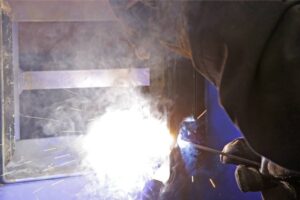
Airflow figures alone do not prove a hood is capturing the contaminant. HSE’s guidance on examining and testing welding LEV says performance should be judged on effective capture of the fume, not just on airflow measurements, and suggests a dust lamp where fume is hard to see. The methods L5 expects the report to record reflect that mix: visual examination, smoke and dust lamp tests show capture, while airflow and pressure readings show whether the plant still delivers its design performance.
The note on how operators use the LEV belongs in the same picture. A hood that tests well but sits too far from the work, or is switched off for part of the job, does not control exposure, and the report is the place where that gets written down.
Pass Labels, Red Failed Labels And Critical LEV Defects
HSE’s LEV FAQs say there is no specific legal requirement on employers or examiners to label LEV. HSE guidance still recommends a test label on or near each hood, and a red Failed label on any hood or system that has failed, accompanied by a short written emergency report describing the fault and the remedial action. Once it has been repaired, a competent person needs to check the repair is effective before the Failed label comes off.
L5 asks employers to address critical defects immediately to ensure adequate control, and to put right any other defect found by an examination or test as soon as possible. The list of critical defects is therefore the first part of the report to read, and the record of what was done about each one belongs alongside it.
Acting On An LEV Test Report And Keeping The Record
HSE’s FAQs ask employers to read and understand the report, raise anything unclear with the examiner, and act on its recommendations. Where adjustments or repairs follow, regulation 9(4) of COSHH covers the record of those repairs as well as the test itself, for the same five years.
A thorough examination and test happens once in up to 14 months, while L5 expects LEV to be visually checked at least once a week. The report’s notes on wear, and on parts that may need replacing before the next test, are most useful in the hands of whoever does those weekly checks.
The repairs themselves are maintenance, carried out by whoever maintains the system. Record the date, the work done and who did it against the hood or component identification used in the report, so the next examiner can see what has changed since the last test.
Checking An LEV Test Report Before It Goes On File
A few questions show whether a report will hold up when an inspector or insurer asks to see it:
- Does it name the process and the hazardous substance, not just the extraction unit?
- Is there a diagram with test points, so the next test measures in the same places?
- Are results given for each hood or extraction point, beside the intended figure?
- Does it say whether the test ran under normal production or special conditions?
- Are critical defects listed separately from wear and minor items?
- Does it say whether intended performance information was available, and what follows if it was not?
- Is it signed, with the examiner’s name, job title and employer?
If several answers are no, send the system list and the last report to info@gsbinspections.co.uk and we will quote for a test that records the paragraph 186 details that apply to your system.
Who Can Carry Out An LEV Thorough Examination And Test
COSHH requires whoever carries out examinations and tests to be competent, and L5 says people examining and testing control measures such as LEV must have adequate knowledge, training and expertise in examination methods and techniques. HSE’s FAQs describe competence as a combination of knowledge, skills and application experience, note that a training course by itself will not make someone competent, and confirm HSE does not require specific qualifications. Employers can carry out the test themselves, though most use a specialist.
Independence matters as well. Where the firm testing an LEV system also installed or maintains it, the report is judging its own work, and the repairs it lists may be work it goes on to quote for. That does not make the report wrong, but an examiner with nothing to sell beyond the examination takes the question away.
LEV Test Report Questions
Is an LEV test certificate enough on its own?
No. COSHH requires a suitable record of each thorough examination and test, and HSE’s Approved Code of Practice lists what that record should normally contain. A label or one-page certificate showing a pass and a date does not carry those details, so keep the full report as well.
How long do we need to keep LEV test reports?
At least five years from the date the record was made, under regulation 9(4) of COSHH. The duty covers the record of each thorough examination and test and of any repairs carried out as a result, and a suitable summary may be kept instead of the full record.
Who arranges the LEV test for hired on-tool extraction?
HSE’s LEV FAQs say that when you hire an on-tool extraction unit, the hire company is responsible for its thorough examination and test, so check with them and watch the expiry date on long hires. If you own the unit, arranging the test is your responsibility.
Do LEV hoods have to be labelled after a test?
There is no specific legal requirement to label LEV. HSE guidance recommends a test label on or near each hood, and a red Failed label with a short written report on any hood or system that fails, removed only once a competent person has checked the repair.
Arrange An LEV Test And Report With GSB
We carry out LEV thorough examinations and tests under regulation 9 of COSHH and issue a written report for each system. We examine and report only. We do not install, service or repair extraction, so nothing we find during a test is work we are hoping to win. With five engineers, we cover a single on-tool unit or a multi-point booth system as readily as multi-site contracts across the UK, and LEV can share a visit with LOLER lifting equipment inspections or pressure system examinations on the same site.
Email the list of LEV systems, the processes they serve and the site address to info@gsbinspections.co.uk, with the last test report and the commissioning report if you have them, and expect a quote back within 48 hours in most cases. If you would rather talk a report through first, call 01782 855481; the call goes to one of the two directors, both senior engineers, and we will still ask for the details in writing. We are an associate member of SAFed, the Safety Assessment Federation.